Writers often ask me whether they should include photos in their books. (Spoiler alert: I most often say no.) They don’t, but should, ask me what content they should cut from their book? Because they don’t realize how self-editing and careful pruning can make their book better.
It may surprise you, but one of the toughest challenges authors face is deciding what to leave out of their book. Much of my work as a writing coach revolves around helping writers figure out what to not include. (One of my self-publishing clients bravely followed my advice to cut an entire chapter from her manuscript. The result was a better book!)
Whether you are writing memoir, fiction or nonfiction, you must decide what to write about, but also—and this is harder—what not to write about. Cutting words you’ve slaved over can be agonizing. Self-editing can be difficult, but it will make your book better. (My most popular Substack post is about the joy of self-editing.) Even so, dumping content can be demoralizing.
Photo by Tima Miroshnichenko: https://www.pexels.com/
While you do need to self-edit, many writers turn to a coach like me to help them decide what to keep, and what to let go of.
Here’s what will make the process less painful: repurposing the things you leave out. Specifically, I’d like to talk about photos and what I’ll call bonus content. Let’s look at three questions:
- What can I do with the paragraphs/chapters/ideas that I edit out of my first draft? How can I recycle it?
- Should I include photos in my book (especially a memoir)? If not, what should I do with all these great pictures?
- Why should I recycle content that doesn’t make the cut? If it’s not good enough for the book, why save it?
How to recycle deleted content
Most writers have a lot of ideas, which can easily turn into a tangled mess of tangents. Staying on topic, or even deciding which topics to include, can be difficult.
A rough draft is just that—rough. Like a stone or piece of wood, it must be polished. And the act of polishing means some uneven edges will be removed, slowly or sometimes in uncomfortably large chunks.
Whether you are writing an essay, a blog post, or a book, the goal is to connect in a meaningful way with your reader. To keep the reader engaged, reading. Your writing should follow a logical flow and be clear and compelling enough that the reader refuses to abandon the connection you’ve forged with them.
That means you’ll have to cut anything that doesn’t accomplish that goal. (I know that’s difficult. My coaching clients struggle with it as well.)
Writers often don’t want to cut their hard-wrought prose. They don’t want anything on the cutting room floor, so to speak. Taking a red pen to their manuscript feels impossible.
The good news is, some of the content you cut, especially from a book, can be recycled.
Readers typically have their phones nearby. Heck, they might be reading your book on their phone. So it’s easy to send them from the pages of your book to the internet. You can post “bonus content” or “deleted chapters” from a book on your website or blog. You can create a “vision board” of photos or quotes that you used as inspiration for your writing and post it online as a look behind the scenes of your writing.
You might even intentionally create bonus content for readers to discover on your website. Author A.J. Harper does this perfectly in her book Write a Must Read. At the end of most chapters in her book, she includes a sidebar that says “Claim Your Reward” and directs readers to her website to “unlock deleted content from this chapter and other cool and useful stuff.” This is brilliant.
You can use this same strategy with your nonfiction book or memoir. For example, you might add a footnote that invites readers to visit your website to see content or photos, and oh, by the way, sign up for your newsletter. The content you leave out becomes a lead magnet you can use to build your mailing list, which you will use to market your book.
Should I include photos in my memoir?
I’m currently coaching a number of writers, some of whom are writing memoir. Memoirists sometimes want to put photos into their books. We are an increasingly visual culture thanks to social media. We expect a photo or video, and plain text might feel boring. However, if you’ve ever had someone corner you and try to show you, say, photos of their vacation or their kids, you know that sometimes, pictures are not as interesting as the person showing them might think. Just because you are writing about your childhood doesn’t mean you should include baby pictures in your memoir.
If you’re considering adding photos to a self-published memoir, here’s a few things to consider.
- Photo quality. Especially for authors using print on demand publishing, the quality of the photos in a book may not be as good the originals. Everything from paper color and quality to printing processes impacts photo quality.
- Production costs. If you add photos, especially color photos, to a book, the production costs rise. Design with photos costs more. Printing costs are higher. You’ll need to charge more for the book to cover your costs, and your already thin profit margins shrink.
- Purpose. Why do you want the photos in the book? If you craft clear and compelling descriptions and engaging narrative, the reader will be able to visualize the people and events in your story. Think about it: most novels don’t have photos. They rely on writing that engages the reader’s imagination. A memoir is a story, based on your own recollections, but it should be written in a clear narrative style that allows the reader to immerse themselves in your experience. You should engage in “show not tell” writing that presents scenes that the reader can easily picture in their heads.
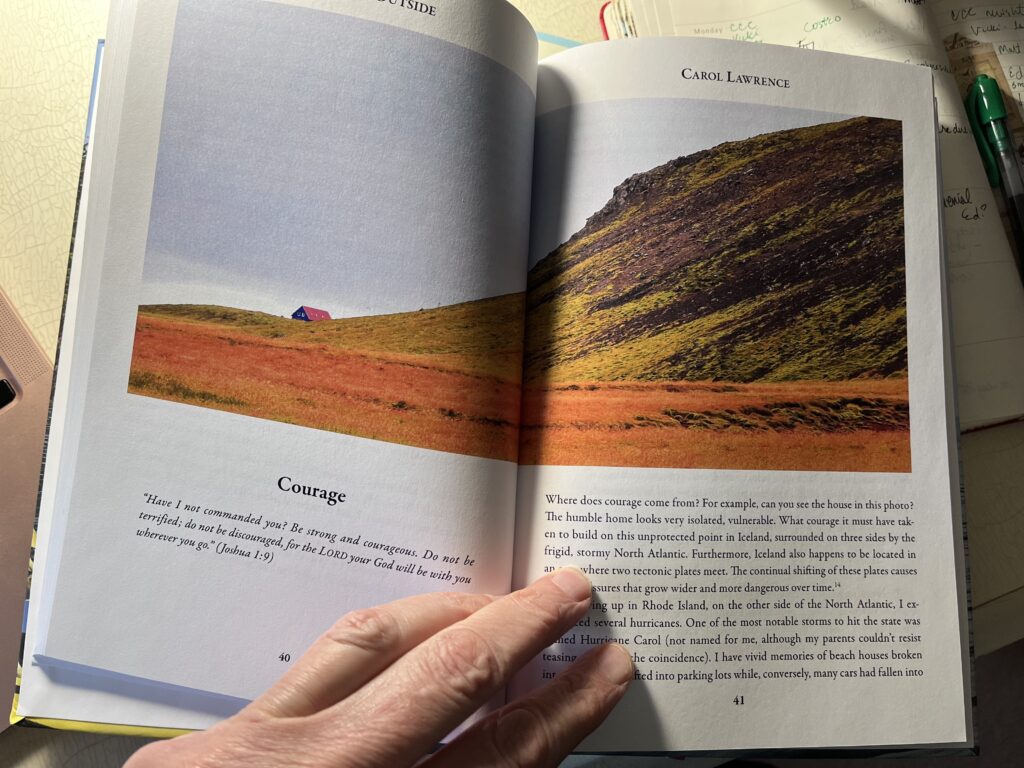
I don’t recommend putting photos in your book, unless of course you are creating a book of focused on photos, like this one that I helped a client self-publish. It’s a collection of essays and beautiful photographs taken by the author. These were very high resolution, carefully edited photos. Not phone snaps of snapshots. If you decide to include photos, make sure they are very high resolution, high quality. Great photos add to a book, but poor quality photos detract from it.
Why recycle your book’s deleted content?
In my kitchen, I have two bins: garbage, and recycling. I have to decide which bin each piece of detritus belongs in. In the same way, once you write a rough draft, there will be pieces that don’t work, extra scenes, sentences, sections. You’ll need to discard them. But can some be recycled?
I recommend that writers use some photos and other “bonus” content as a way to connect with their readers beyond the pages of their book. I am not recommending that you recycle content that is of poor quality. If it’s garbage, you know which bin it goes in. Rather, I’m talking about stuff that is well-crafted or helpful, but just doesn’t fit into your book. Tangential but not terrible. So find a new home for that useful stuff.
Why should you recycle content? Because writers need to connect with their readers, not just in their books, but in other connections: blog posts, newsletters, social media, speaking. You can reuse content to build connection via other channels. When you know you’re going to repurpose or recycle content, it helps you do two things:
- It makes it easier to self-edit and cut things that you might really love but don’t add to the story or align with the topic.
- It provides a way to market your book by inviting readers to your website or socials and offering them “bonus” content.
Leave a comment: have you ever used extra content from a book or blog post? Tell us about it? Do you agree or disagree about photos in books? Tell us why!
Like this post? It’s taken from the Powerful Story newsletter over on Substack. Subscribe for free and get content like this in your inbox each Friday!